
Unforeseeable Things: On hybridity, adoption, and finding one's own language
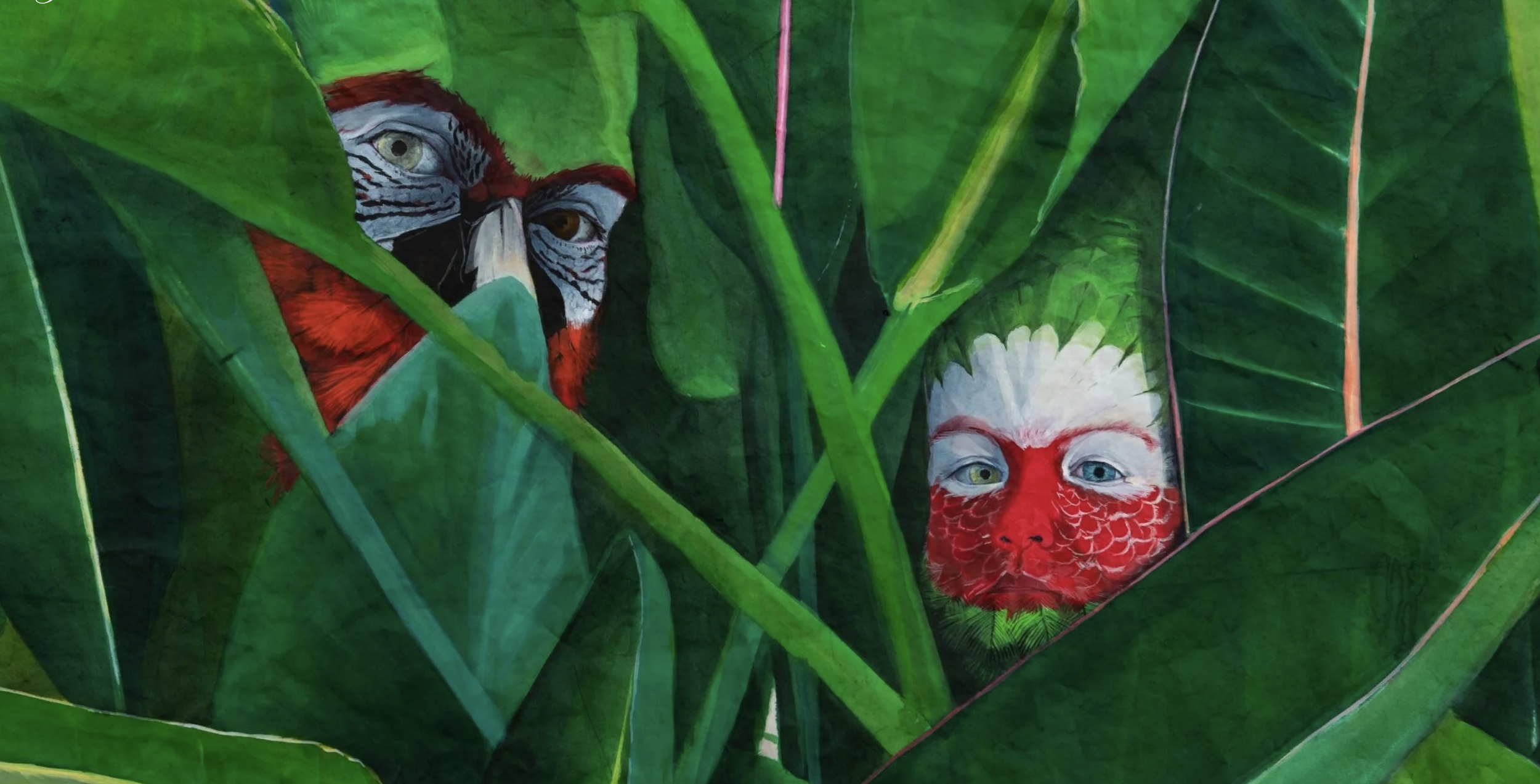
Yaron Hakim, Self-Portrait as a Hybrid Guacamaya with son (detail), 2021. Photo by Ruben Diaz. Courtesy of the artist.
Yaron Hakim in conversation with Jessica Cowley
Introduction
Alamo therapist Jessica Cowley sat down with artist Yaron Hakim to speak about his work, becoming an active member of the international adoptee community, and how adoptive parents can best support their children.
Yaron is a Los Angeles-based artist who was adopted from Columbia by white Jewish parents and grew up in Switzerland, Australia, and the United Kingdom. His artwork has always dealt with issues of self and identity, but he has more recently begun to focus specifically on his own and others’ experience of adoption.
Jessica specializes in working with members of the adoption constellation as well as prospective adoptive and foster parents.
This interview has been edited and condensed for clarity.
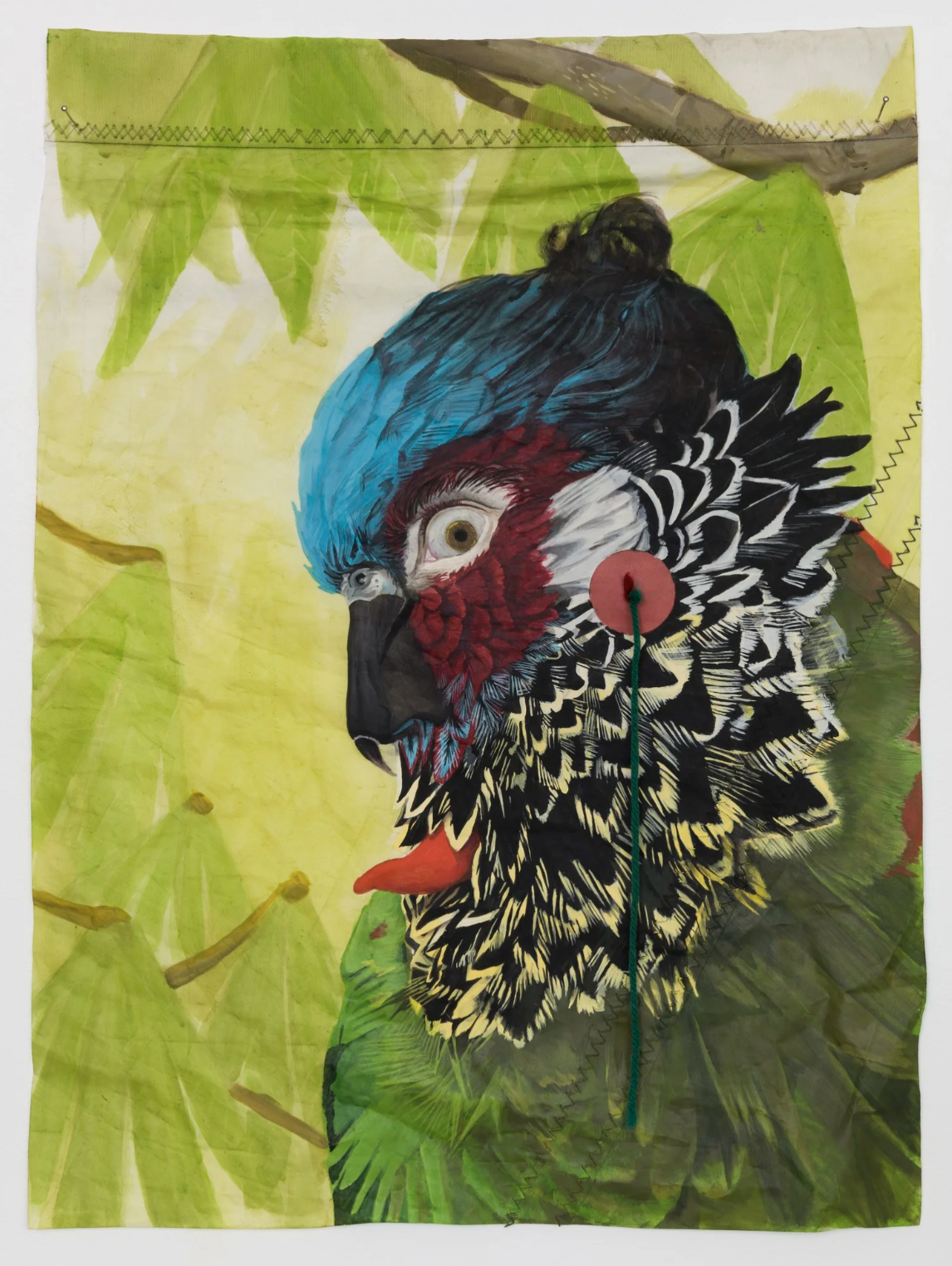
Yaron Hakim, Self-Portrait as a Pyrrhura Perijá Picta, 2019. Photo by Ruben Diaz. Courtesy of the artist.
Jessica Cowley: We first met in 2021 at your show, Psittaciformes, in Santa Ana. I found it so moving to see you grappling with issues of identity and hybridization. In that series of paintings, there are some beings that look angry, or even scared. And then there are some that are more self-assured, even confrontational, addressing the viewer. It seems like there’s movement from disembodiment towards embodiment. I’m sure it wasn’t linear, but I’m curious if you noticed the paintings in the series changing over time.
Yaron Hakim: If we put the paintings chronologically they probably would be moving from less sure to more assured, but I do think they oscillate. Towards the end there was definitely more confidence both in the way that they were painted and in how the figure is addressing the viewer. In the beginning it was all so scary to me.
JC: Tell me more about that.
YH: I've been making work about belonging since I can remember. But it's only in these self portraits that I’m addressing this directly and on a personal level. Before, it was all hiding behind philosophical ideas, or trying to create spaces of autonomy. And that switch was hard to do. First of all, at the time, I was thinking, “who is making self portraits right now?” And my internal monologue was quite abusive. Like, “Why are you doing this? This is the stupidest thing. Who cares?” It was constant, but I couldn't stop painting. That was a weird thing. To have this internal monologue that was so mean, and then this other part of me that was really excited about painting these illusions of hybrid bird men.
JC: I'm thinking about that harsh voice inside, and it sounds to me like it’s saying. “Don’t expose yourself! Don't be vulnerable in this way. What if I’m vulnerable in this way and…?”
YH: Oh, yeah, total rejection!
JC: But then I think about the wisdom of the part of you that says “there’s something here.” I was also reminded of the nose flutes you made as part of this body of work, which helped you answer the question, “How can I communicate with the displaced parrots that became wild around here?” And how often language works against us when we're trying to understand what's going on emotionally. How do we transcend these negative voices inside us? How do we communicate beyond language?
YH: I find it difficult to express how I feel with language. Maybe that was part of the drive. I don't think of the work as a catharsis or anything like that, and I also shy away from the idea that I have an inner voice guiding me down this difficult path to process things. But another side of me thinks, well, maybe this is exactly what is happening!
JC: Why do you shy away from that?
YH: Because it sounds aloof…nouveau spiritualism, doing yoga on the beach with a goat or something—you know what I mean?
JC: Ha! I think we're made up of multiple selves, as your paintings so well express. Maybe there's the part of you that says, “Tsk tsk tsk, better not!” And then there's a part of you that asks, “But what if I did? And what if it's well-received? What if I’m accepted?”
YH: I never thought about whether it would be received or accepted. I just felt like I just had to do it. There was a lot of desire to make it. A drive.
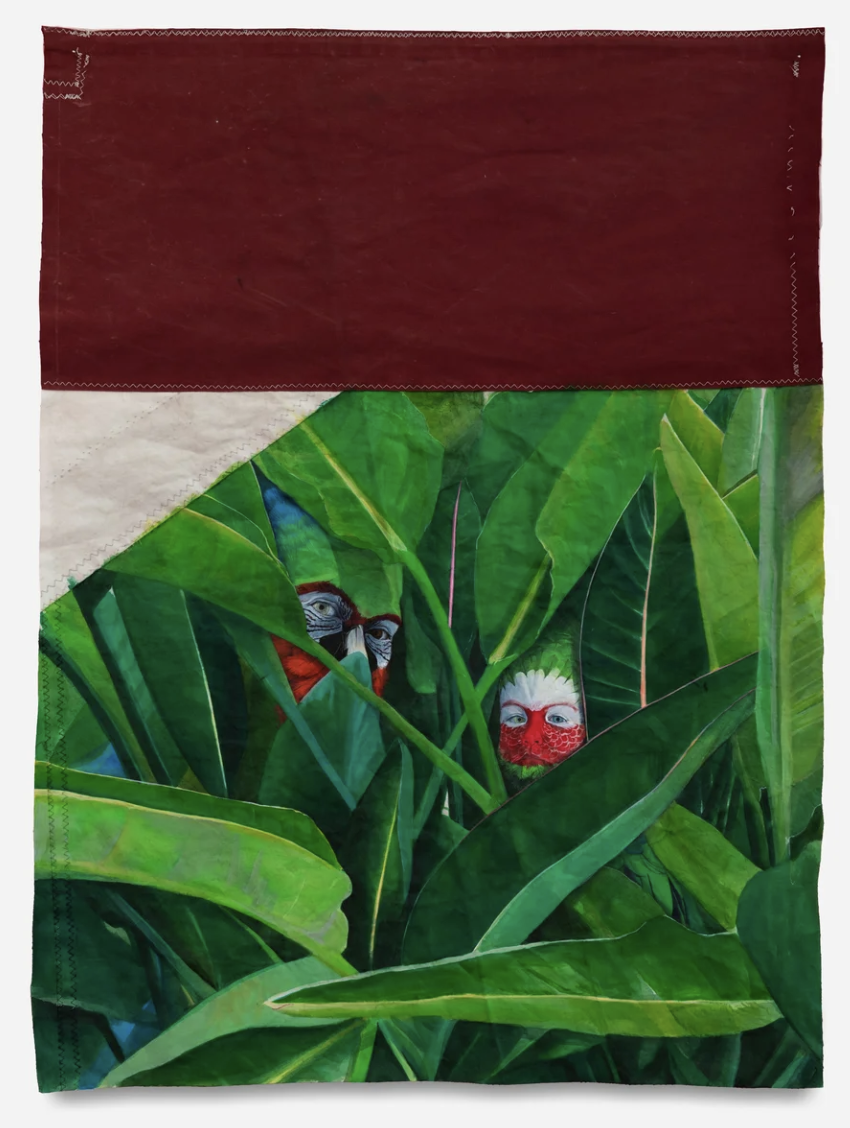
Yaron Hakim, Self-Portrait as a Hybrid Guacamaya with son, 2021. Photo by Ruben Diaz. Courtesy of the artist.
JC: There are a couple specific pieces in that body of work I wanted to talk about. One is the painting of you and your son, Self-Portrait as a Hybrid Guacamaya with son (2021), which was so emotional for me the first time I saw it. You’re both hiding, peeking out from your own little cloistered world. And I'm also thinking about the piece that was at MOCA last year, Self-Portrait as a Pink-Fan Santa Marta Ara Rubrogenys (2023), which is massive, and the figure is almost preening.
YH: The one at MOCA was one of the last parrot self-portraits I painted, and the one with my son is somewhere in the middle. You're right, some of them are hesitant or trepidatious. The reference images I was using were mostly from wildlife photographers, and the birds sometimes looked caught off guard. They’re just doing their thing and then they notice a camera person. That was something that I was attracted to because it hit upon feelings of hypervigilance, trying to constantly control other people's perceptions of me as a way to survive. I definitely wanted that to be present in the work. So even though there's playfulness, there's anxiety too.
I painted the piece that was at MOCA after I had already gotten some recognition for the work, so I might have felt less… well, now I'm trying to psychoanalyze that painting! [laughs] But that one for me is very playful. I'm also thinking about historical painting and trying to recontextualize it, by being in dialogue… Adoptees are not present in art history, we don’t think of an “adoptee artist.” And people of color are definitely not in the old canon either. Art history is Eurocentric. So, I’m trying to insert myself into that history in a playful manner. There was something about the palm frond behind the head that reminded me of Botticelli's Birth of Venus. She’s kinda doing this whole thing [poses like Venus], modestly covering herself and I decided I’m gonna play with that.
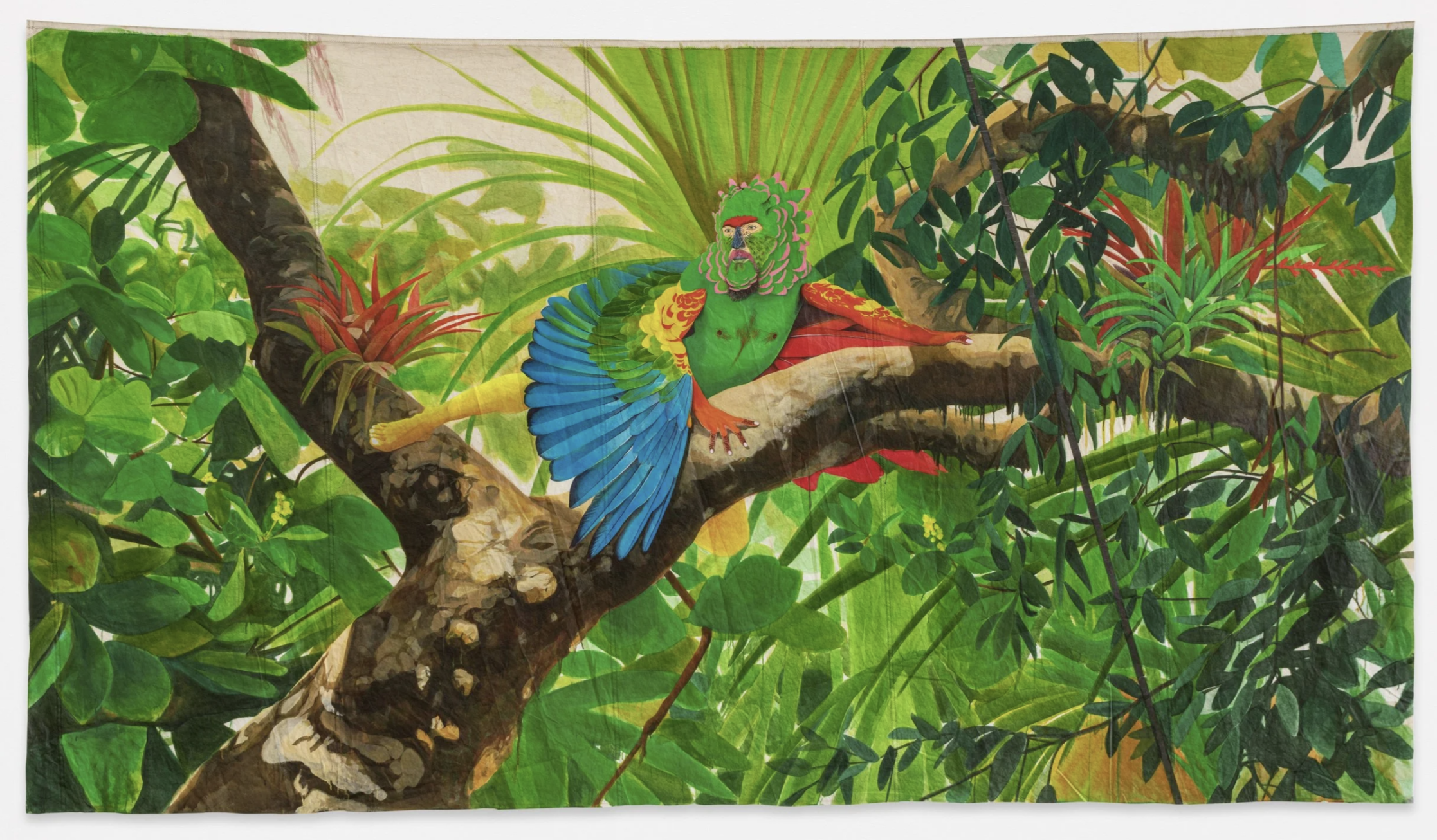
Yaron Hakim, Self-Portrait as a Pink-Fan Santa Marta Ara Rubrogenys, 2023. Photo by Evan Bedford. Courtesy of the artist.
JC: Oh, 100%, that comes out. It also reminds me of the dances that birds do to attract a mate, fan the wing, that sort of thing.
YH: Desire is another aspect of it. I’m coming to realize that one way I’ve related to the managing of people’s perception is also using tactics of desire – how can I make myself more desirable, right?
JC: “How do I make myself more desirable…” I'm curious if that’s been with you most of your life. That was definitely present in my childhood as well… feeling very different from my family but also being very concerned with how I was being received by my elders, by teachers… Always wondering, am I being pleasing enough? Though I don’t think I was conscious of it at the time, it took a lot of therapy to realize! Being a person of color adopted by white parents, I’m wondering how you experienced that difference, and how that might intersect with the desire to manage people’s perceptions of you.
YH: I don’t have a very good memory of my childhood. My sister tells me I don’t remember anything, really. But I remember my teen years in Switzerland.
JC: I know there's much more immigration now, but I’m guessing there weren’t a lot of people of color around.
YH: Not a ton, but I went to an international school. There were a lot of children of UN diplomats, so it was diverse, but still majority white. With the UN being the backdrop for our school it felt very amicable. But outside of that you could feel totally… watched. Going to stores, or crossing a border.
I was just talking to another adoptee who's also adopted from Colombia, and I asked him, did you have that kind of trouble? And he did. But I also noticed that when I turned 40 or so, there was less profiling.
JC: What do you make of that?
YH: I have no idea! Maybe because I have a family and a son I’m less threatening now? White hairs? Who knows. But I remember if I was traveling with friends I’d tell them at the passport check, it’s gonna take longer for me than for you guys, I’ll see you on the other side. And it was like clockwork.
JC: That sounds exhausting.
YH: Yeah, but you get used to it.
JC: Sure, but I imagine the fact that you have to get used to it is very wearing.
YH: What my parents didn’t and couldn't provide me with was knowledge that I might experience colorism. They did however make very aware of antisemitism. I also think there are a lot of assumptions when you have a last name that's Arabic, an Israeli first name and have Colombia as your birthplace…stereotypes that I had to navigate. I think the nose flutes go there, thinking about racial profilings, but also about the stereotype of Jewish noses and playing with that.
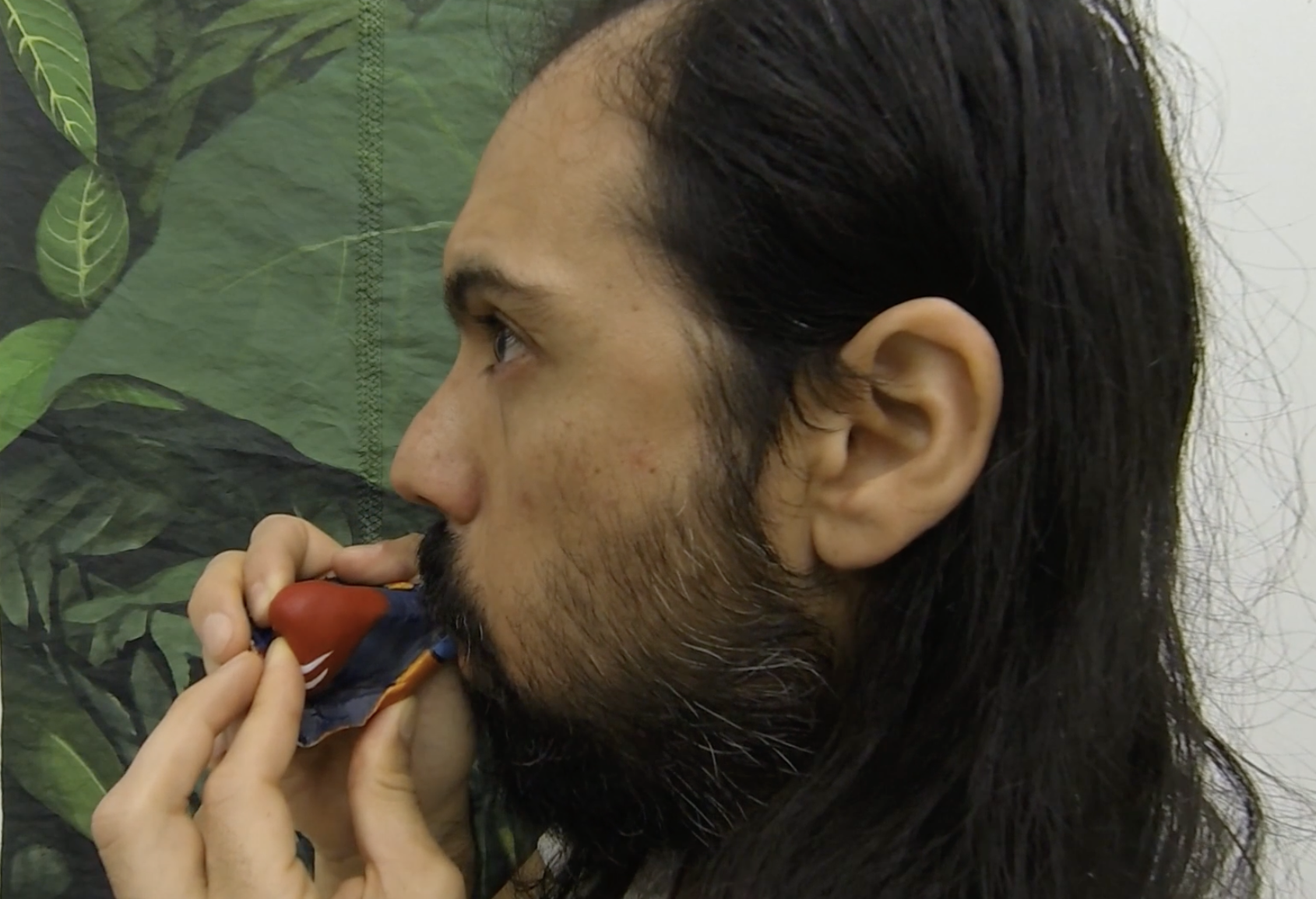
Still from video of Yaron Hakim playing Nose Flute, https://vimeo.com/506201844
JC: I remember in your thesis project, you wanted to create an “autonomous nation state.” It’s such a strong symbol of stepping out, maybe away from stereotypes and the family, saying, “I am my own thing, I have my own rules and laws.” But it’s also lonely to be a one person autonomous nation-state!
YH: I don't explain it quite like that, but that is actually more true to what got me to start that project. This idea of taking refuge in my artwork, an initiation and transformation. I was taking a big risk with that project, building something that I don't know how to build (an outrigger sailing canoe, and then sailing it in the Pacific and hopefully surviving! Which all worked out, obviously. In a way I was marking a new direction for my work. Perhaps the reason why I started making self-portraits is because of that ritual that I created. That piece was supposed to be called “Initiation,” but then I switched it up.
JC: Oh, wow!
YH: There’s a line in the Dhammapada where the Buddha says if you can’t find a good teacher to follow, you should make an island unto yourself. That’s always resonated with me, that idea of being self-reliant. But I also know it sounds lonely, and I’m starting to see the correlation between that and my difficulties with commitment. It’s something I’m working on.
JC: I think all the time about how much this is present for so many clients, and in my own work with my therapist. Self-reliance is responsible for so much good in my life, and it is also my greatest Achilles heel. Like, “No, no, no, no, I can do it, I don’t need logistical or emotional help!” And how that can put up such a wall with people.
YH: Well, it stops one from being vulnerable.
JC: Exactly. Because relying on people is unpredictable, which is tough for people who don’t like a lack of control! For me, this seems like a good time to consider the progression in your more recent work. In this series, you are incorporating stories from the community of adoptees, and I'm wondering what that transition has been like for you emotionally.
YH: It's been eye-opening. I'll do interviews with fellow adoptees, and then I'll paint them or make a gourd engraved with a family tree, or both. When they're telling me their story, it gives me a way to put language to my own experience. Like I mentioned earlier, I'm not very good with expressing emotions–I often feel confused about them. But when the adoptees I interview are so clear and in tune emotionally, it's liberating for me to just hear their story. In a way, it helps me access feelings of loss and grief… It’s somewhat selfish, because I feel like I'm getting a lot from them too, beyond material to make work.
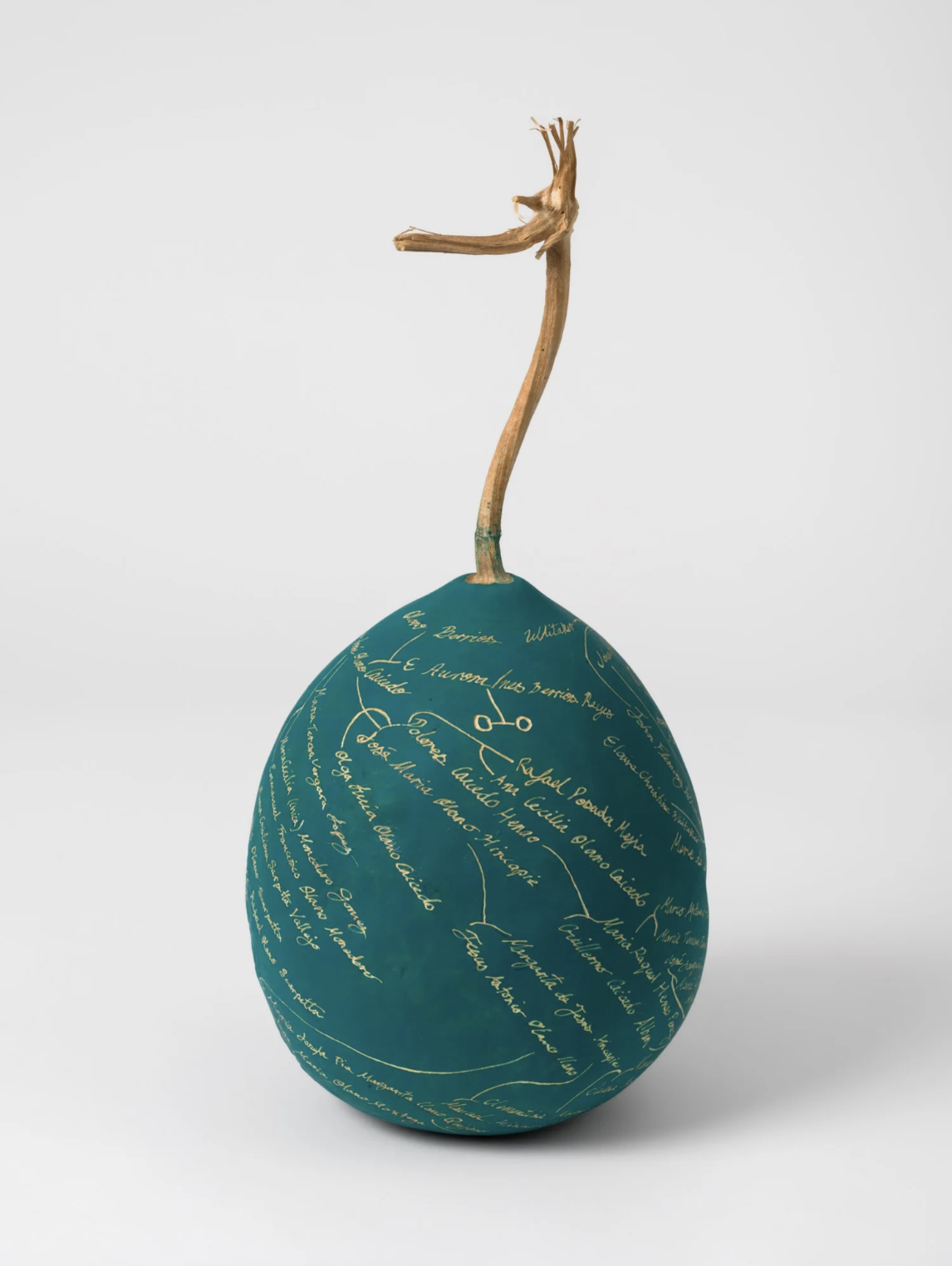
Yaron Hakim, Ancestor Gourd (Leslie), 2024. Photo by Ruben Diaz. Courtesy of the artist.
JC: I imagine that they're getting a lot from you as well!
We were talking earlier about different ways to make meaning of our experiences, and they're giving you the language and then you're providing them with this amazing symbolic representation that is laden with emotion, if not language.
YH: There's a symbiotic thing going on for sure, a back and forth. These relationships that I'm building are unique and powerful because of our shared experience. I just went to the BIPOC Adoptees conference and I've never felt more belonging in my life.
JC: In the last couple of days I’ve seen stories on Instagram of adoptees you met at the conference going to see your show in New York. And they were saying, “Well, I didn't have to look at the wall text to see which painting was made by the adoptee!”
YH: Oh, yeah, yeah. They know. They know.
JC: What's it like to get that feedback?
YH: I've never thought of myself as having a specific audience, but after seeing those posts I’m thinking maybe I do have a sub-group secret audience! But I also feel that the issues adoptees face are relatable to a lot of groups. Anybody who’s feeling ambiguity around immigration, race, queerness—any form of identity that’s not “white-hetero,” right? There’s a feeling of this in-between state that resonates with all types of people. Even though it's very specific to the adoptee experience, I think it also has a larger reach.
JC: I imagine you might not want to be pigeonholed as an “adoptee artist.”
YH: Well, my big fear is to be the parrot guy.
JC: That’s fair!
YH: I’ve come to realize I have a low threshold of acceptance for how I am. A dismissal like, “Why don’t you just get over the fact that you’re adopted, it’s not a big deal!” Even saying that word, “trauma,” I think, is it really? Or, “You grew up in a predominantly white environment, are you really a person of color?” I learned at the adoptee conference that these are all common feelings, and that a lot of us are actively reclaiming our lost heritage, which is important.
JC: Does hanging out with other adoptees help you acknowledge that, yes, this was a very impactful experience on my life?
YH: Yes! It's affirming. At the conference, everything was so meaningful and again gave language to experiences and feelings I have. When you’re an adoptee, you can feel very alone, like you are the only one. It took me until I was about to have a kid to realize that maybe all the anxiety I’ve experienced in life has something to do with my adoption. It’s taken me a long time to accept that adoption is a trauma. And that feeling for me is the loneliest place. It’s an endless abyss of nothing. I think all adoptees are intimate with that feeling.
JC: Wow. Have you read Journey of the Adopted Self?
YH: Yes.
JC: There's this image in there that has really stuck with me of, if I'm remembering correctly, a baby who's floating off in space. He's tethered to earth by this tiny string, with a feeling of, "I'm just out here completely on my own.”
YH: It’s terrifying.
JC: That “endless abyss of nothing.” I feel like therapy can be a place to microdose the abyss [laughs] – and the therapist can serve as a tether, so you don’t float off into space alone. So those dark places can slowly become more integrated into yourself. I also realize a lot of people don’t want to go there!
YH: I think I do. I didn’t before. Now, I think I have to. Otherwise I’m just going to avoid it. Though there are also other ways I touch fear—the paintings, for example, or the boat.
JC: Are the portraits in your more recent series Antecedents, (2024-present), based on your interviews with Colombian adoptees, of real or imagined birth mothers?
YH: Both. Some are based on the mothers of people who are in reunion, or sometimes they're based on a photo an adoptee has of their mother who passed before they were able to meet. For a couple of portraits, I used my cousin,whom I was able to connect with through DNA testing, as the stand-in for my birth mother. In many ways, she's the closest thing I have to my birth mother, even though we're almost the same age.
The most recent ones that you've seen are portraits of two twins who were adopted together, and I painted the twins as themselves but they could also be their mother.
JC: But the faces are obscured by fruit or flowers.
YH: They are. In the portraits of the twins, a single eye is present in each. I wanted the eye there because I think the gaze is important, more arresting. More tense. And in their case either eye could be their mother’s.
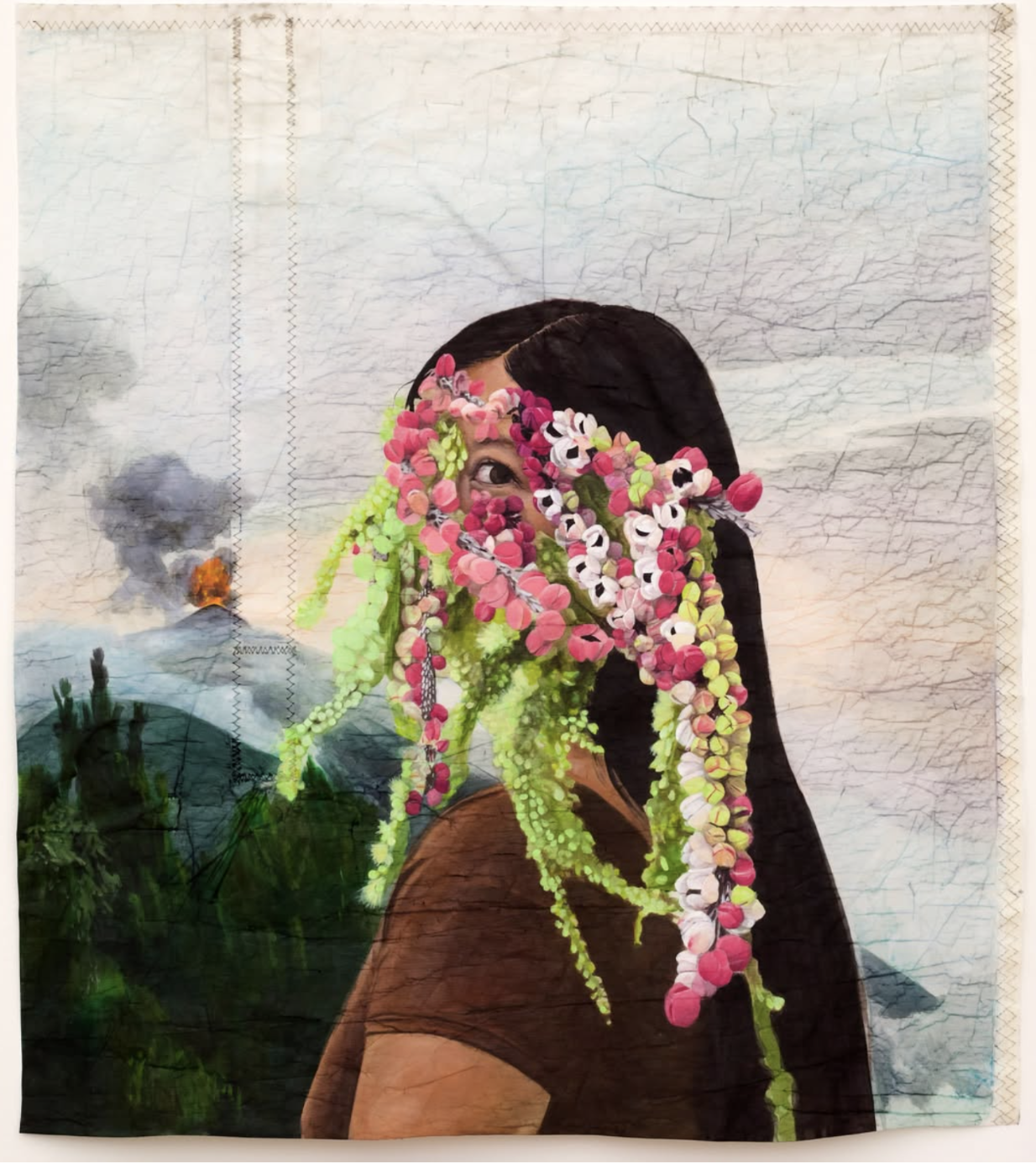
Yaron Hakim, Maíz Tostado (Angel), 2026. Photo by Nick Knight. Courtesy of the artist.
JC: Another thing that came to mind is the fantastical element in all of these paintings, the surrealist element, and it reminds me of this concept of the ghost kingdom.
YH: Yes!
JC: It seems like some of these paintings are an imagining of what could have been in an alternate reality.
YH: I think it is exactly the ghost kingdom. It's also taking a magical realist approach which is very…
JC: Latin American!
YH: Latin American, and Colombian! There's a lot of folkloric mysticism happening in regular life there, like in 100 Years of Solitude. There's a lot of leyendas, a mash-up of all of these things. Latin America is a beautiful place to think about hybridity, mixing, and new things coming together from disparate places.
JC: There's a long tradition of that in Latin America. A long, fraught history.
YH: Totally! But I'm also realizing that, without that history, we don't have all these beautiful things. There's a lot of amazing things that have come out of that tragic history because unforeseeable things came into contact . Maybe I'm just trying to find a positive! But cumbia doesn't happen without that.
JC: Well, both things can be true!
YH: Both things can be true. And that's the key, right? I'm interested in that ambiguity, too, the two sides, the holding of it all. It's difficult.
JC: That’s one of the things I love about these paintings. Is the parrot scared and being captured? Is the parrot preening and seducing? Is the parrot hiding? There are many different answers, and they all have elements of truth to them. Maybe sometimes all three, depending on the day!
YH: I like that. That's what I want the work to be, even though I struggle with the complexity too. But I would much rather be in a messy and complex world than a really black and white one.
JC: I have one last question: Is there anything from your particular perspective that you would want adoptive parents to consider or know?
YH: That's a big question. I would say, if you’re adopting trans-racially, don’t be color blind. For a long time, I didn’t realize I wasn’t white! And I grew up in Europe and Australia, in this country it’s even more…
JC: Vital.
YH: It’s every day.
JC: And a negation of a part of yourself that’s a harmful erasure. In this country, especially, it can be a danger for your child.
YH: It's really complicated. It negates a whole aspect of identity-building as a child. I would also say adoptive parents should make themselves aware of all the resources that are out there for adoptees.
JC: Yes! All of these groups you're finding and participating in.
YH: It’s so important. I don't think they existed before. At least I was unaware of these resources until very recently. And then there are all these people doing advocacy in their respective birth countries, fighting for adoptee rights. It's a whole movement now.
JC: So, make yourself aware of the resources, and get educated.
YH: I would also say adopted kids should have adoptee friends. Do you know about Adoption Mosaic?
JC: Yes, I'm familiar with their work! They have a new program specifically for adoptive parents, right?
YH: Yes! They have a lot of cool things that aren't just geared toward adoptees but for the whole triad. And they've been doing it for so long that they have a lot of resources.
JC: Any other recommendations?
YH: If we're talking about adoptees and adoptive parents, I think it's important that everybody's in therapy. Everybody!
JC: Well, of course I’m not going to argue with that!
RESOURCES FOR ADOPTEES & ADOPTIVE PARENTS
BIPOC Adoptees
https://www.bipocadoptees.org/
Adoption Mosaic
https://adoptionmosaic.com/
Center for Adoption Support and Education
https://adoptionsupport.org/
I Am Adoptee
https://www.iamadoptee.org/
Yaron Michael Hakim (b. 1980 Bogotá, Colombia) lives and works in Los Angeles. Hakim received an MFA from the University of California (Irvine, CA) in 2013 and a BFA in Painting from the Maryland Institute College of Art in 2002. He has had recent solo exhibitions at Sargent’s Daughters (Los Angeles, CA), California State University (Sacramento, CA), Grand Central Art Center (Santa Ana, CA), Hernando’s Hideaway (Miami, FL), and LAXART (Los Angeles, CA). His work has been included in group exhibitions at Tanya Bonakdar (Los Angeles, CA), Praise Shadows (Boston, MA), and California State University (San Francisco, CA), among others. Hakim’s work has been featured in Los Angeles Magazine, The Wall Street Journal, Hyperallergic, Georgia Review, and the Miami New Times, among other publications.
Hakim’s artist book, Yaron Michael Hakim: Psittaciformes was published with Grand Central Art Center and X Artists’ Books in September 2023.
His work is in the permanent collections of the Los Angeles County Museum of Art (Los Angeles, CA), Winthrop University (Rock Hill, SC), the Museum of Contemporary Art (Los Angeles, CA), and the Peréz Art Museum (Miami, FL). He is represented by Sargent’s Daughters.